


eCall
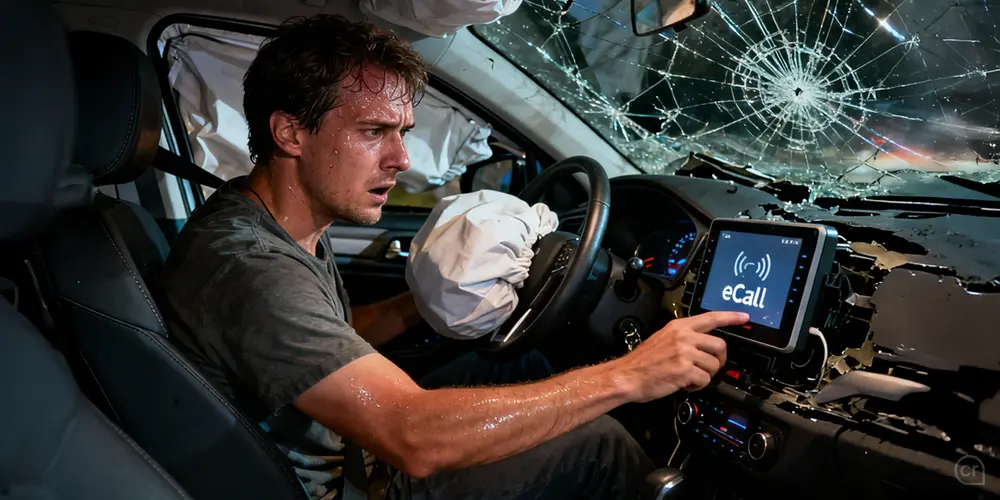
eCall
eCall is an automatic emergency call system for vehicles that automatically dials 112 in the event of a serious accident and transmits important information such as location and time of accident to the relevant control center. The aim of this system is to get emergency services to the scene of an accident faster, reducing the number of road deaths and the consequences of accidents.
Technology
Vehicles with new type approval from 2018-04-01 must be equipped
with eCall. The system is based on a navigation receiver installed in the vehicle via GPS and Galileo as well as 2G and 3G mobile communications and automatically
triggers a telephone connection to the emergency number 112 after a serious accident. The emergency
call system can also be triggered manually in the event of urgent medical problems. For this
purpose, an SOS button is installed in the car, often located on the headliner. When triggered
automatically or manually, the following data is transmitted:
- Time of accident
- Manual or automatic activation
- Vehicle identification number (VIN)
- Vehicle class and drive type (petrol, diesel, gas, electric)
- Last two vehicle positions
- Direction of travel of the car
- Seat belts fastened at the time of the accident
- Optional additional data
NG eCall
Since eCall was designed in 2018 based on the 2G and 3G mobile communications standards, the shutdown of 3G in 2021 and 2G by the end of 2030 at the latest, there was a need for a more modern system. This is provided by Next Generation eCall, which uses the 4G and, in the future, 5G mobile networks. From 2026-01-01, cars with new type approval must have Next Generation eCall, and from 2027-01-01, all new vehicles must have it. In addition to the data already transmitted by eCall, Next Generation eCall can also transmit live images from the scene of the accident or health data of the occupants, if they have given their consent. In Germany, Deutsche Telekom, Vodafone, and O2 Telefónica support NG eCall since the beginning of 2026. 1&1 does not yet support NG eCall as there are currently no contracts for fleet SIM cards with automobile manufacturers.
NG eCall
Deutsche Telekom, Vodafone und O2 Telefónica unterstützen seit Anfang 2026 NG eCall. 1&1 unterstützt NG eCall noch nicht, da bislang keine Verträge für Flotten-SIM-Karten mit Automobilherstellern bestehen.
Legal
EU Directive 2015/758, which came into force in May 2015, required member states to introduce eCall.
Statistics
In 2024, 136,000 eCall emergency calls were triggered in Germany
(source:  Telekom).
 Advanced Mobile Location
 Back to main page